By CubixKraft Team
AI Agents vs Chatbots: What's the Difference and Which Does Your Business Need?
If you've been told that adding a chatbot will "automate your customer support," you've only heard half the story. In 2026, the gap between a chatbot and an AI agent isn't a matter of degree — it's a fundamentally different technology, with fundamentally different outcomes for your business.
The Quick Answer
Here's the simplest way to understand the difference:
- Responds to messages in a conversation window
- Follows pre-defined scripts or FAQ flows
- Lives in one channel (usually a widget on your website)
- Waits to be spoken to — then answers
- Has no memory between sessions
- Cannot take action in external systems
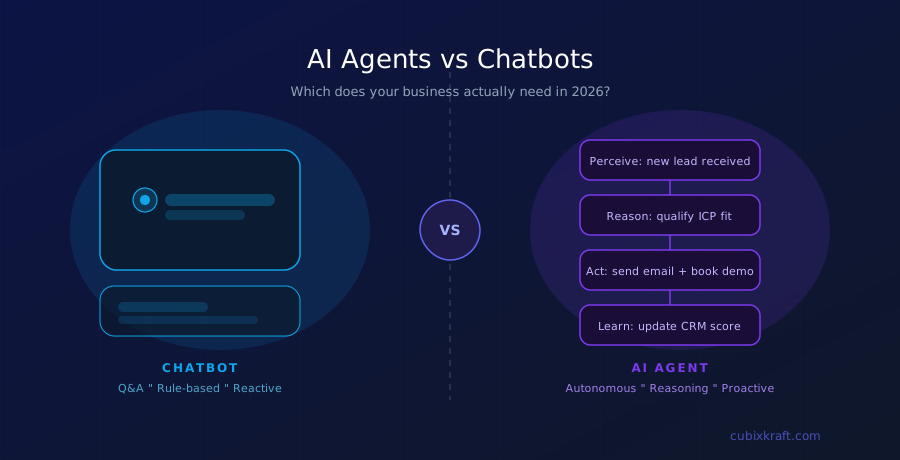
- Perceives events, reasons, and takes autonomous action
- Uses AI to adapt to novel situations and ambiguity
- Works across your entire stack — CRM, email, APIs, databases
- Proactively initiates actions based on triggers
- Maintains persistent memory across interactions
- Can update records, send emails, book meetings, and more
In short: a chatbot is a smarter FAQ page. An AI agent is a digital team member that actually gets work done.
Why Chatbots Hit a Ceiling Fast
Most businesses start their AI journey with a chatbot — and there's nothing wrong with that. For simple, high-volume Q&A scenarios (store hours, return policy, pricing), a well-built chatbot works fine.
But very quickly, you run into the chatbot ceiling. Here's what it looks like in practice:
A customer asks your chatbot about an order status. The bot doesn't have access to your OMS, so it says "Please contact our support team." The customer emails your team. A human logs in, checks the system, and replies hours later. You've automated the first message — and made everything else slower.
This is the core problem: chatbots talk, but they don't act. They can't look up your customer's actual order. They can't process the refund. They can't update the CRM. They can't send a follow-up 48 hours later. Everything still requires a human in the loop — the chatbot just sits at the very front of the queue.
The hidden cost of chatbot-only automation
When a chatbot fails to fully resolve a query (which happens often for anything beyond basic FAQs), customers escalate to human support. But now they're frustrated — they've already spent time with the bot. Research consistently shows that customers who had a bad chatbot experience before reaching a human are significantly more likely to churn.
You've spent money on a chatbot, annoyed your customers, and increased the pressure on your support team. That's not automation — that's a bottleneck with a friendly face.
What AI Agents Can Do That Chatbots Can't
An AI agent doesn't just communicate — it acts across your entire software stack. Here's what becomes possible:
AI agents can integrate with your CRM, your order management system, your calendar, your email, your data warehouse, and your internal tools — all simultaneously. When a trigger fires (a new lead, an inbound email, a threshold being crossed), the agent perceives it, reasons about what to do, takes action, and logs everything — all in seconds.
"A chatbot is a better form field. An AI agent is a better hire."
Side-by-Side Comparison
| Capability | Chatbot | AI Agent |
|---|---|---|
| Natural language understanding | ✓ Basic | ✓ Advanced (LLM-powered) |
| Multi-turn conversation | ✓ Within session | ✓ Persistent across sessions |
| Take action in CRM/ERP/OMS | ✗ No | ✓ Yes — read & write |
| Send emails / book meetings | ✗ No | ✓ Yes, autonomously |
| Handle novel/unexpected queries | ✗ Falls back to human | ✓ Reasons through ambiguity |
| Initiate actions proactively | ✗ Reactive only | ✓ Trigger-based proactive action |
| Work across multiple channels | ✗ Usually single channel | ✓ Email, chat, voice, API events |
| Coordinate with other agents | ✗ No | ✓ Multi-agent orchestration |
| Learn and improve over time | ✗ Static scripts | ✓ Continuous improvement |
| Full audit log of actions taken | ✗ Conversation log only | ✓ Every decision traceable |
| Setup complexity | Low | Medium (with the right platform) |
| Cost relative to human staff | Low | Low-medium, high ROI |
When a Chatbot Is the Right Choice
Chatbots still have a place. Be honest about your situation — if the following describes you, a chatbot may be a perfectly reasonable starting point:
- You get high volumes of simple, repetitive FAQs
- Your queries require no system access or action
- You want a fast, low-cost first automation step
- Your team can handle all escalations efficiently
- You need to capture lead info and route to humans
- Your team is overwhelmed by repetitive manual tasks
- Customers need real actions taken (refunds, bookings)
- You want 24/7 autonomous operations across channels
- You're losing leads because of slow follow-up
- You need end-to-end workflow automation, not just chat
When You Definitely Need an AI Agent
There are situations where a chatbot simply cannot solve the problem — and continuing to use one will cost you in customer satisfaction, revenue, and team morale. These are the clear signals you need an AI agent:
Your support team is drowning in tier-1 tickets
If your support engineers are spending 60% of their time on repetitive queries that follow predictable patterns — "Where is my order?", "How do I reset my password?", "Can I change my subscription?" — an AI agent can resolve these end-to-end, not just respond.
Leads are going cold because follow-up is slow
Data consistently shows that responding to a lead within 5 minutes versus 30 minutes increases conversion likelihood dramatically. If your sales team can't reach every lead within minutes, an AI sales agent can — qualifying, engaging, and booking — around the clock.
You're running complex multi-step workflows manually
Invoice approval, employee onboarding, partner data sync, monthly reporting — any workflow with more than 3 steps that runs on a schedule or trigger is a candidate for AI agent automation.
Real Business Scenarios: Chatbot vs Agent
Chatbot: "I'm sorry to hear that. Please email support@yourcompany.com." — human follows up in 24 hours.
AI Agent: Reads the order details, checks the refund policy, confirms eligibility, initiates the refund, sends a confirmation email, and updates the CRM — in 60 seconds, at 2 am.
Chatbot: "Thanks for reaching out! Someone will be in touch soon." — sits in a queue.
AI Agent: Enriches the lead data, scores ICP fit, sends a personalised email within 90 seconds, books a slot in the closest available rep's calendar, and creates a CRM record with full context.
Chatbot: Not applicable — chatbots don't monitor systems.
AI Agent: Detects the anomaly, diagnoses likely cause, creates a Jira ticket, triggers a remediation workflow, and sends a Slack notification to the on-call engineer — all before anyone wakes up.
The Next Step for Your Business
The businesses winning in 2026 aren't the ones with the most headcount — they're the ones with the smartest autonomous operations layer. They've moved past chatbots into a world where AI agents handle entire workflows, coordinate with each other, and free their human teams to focus on high-judgement, high-value work.
The good news: you don't have to replace everything at once. Start with one high-impact workflow — maybe lead qualification, maybe refund processing, maybe tier-1 support. Deploy an AI agent there, measure the results, and expand from there.
At CubixKraft, we help businesses make this transition through our Autonomy Cloud platform — a full-stack environment where your AI agents, their integrations, decision logic, and oversight controls all live in one place. You stay in control; your agents do the work.
Stop Automating Conversations. Start Automating Outcomes.
Talk to the CubixKraft team about your first AI agent deployment — we'll help you identify the highest-impact workflow and get it live fast.
Start the Conversation →